
DEIJ
Benioff Scholars
Propelling future leaders in applied environmental science
Overview
The Benioff Scholars Program in Applied Environmental Science at UC Santa Barbara supports graduate students whose work translates research into real-world environmental solutions. The program is designed to empower UCSB-affiliated students to pursue applied, impact-driven research that addresses urgent environmental challenges.
Program Details
- Current and incoming UCSB graduate students (PhD or Masters) in good standing.
- Students from any department are welcome; previous recipients are not eligible.
- The potential value of the proposed research for creating or applying solutions to a threat of immediate concern for the environment.
- Demonstrated excellence in academic or professional practice.
- Letter of recommendation from the graduate student’s advisor.
- Contribution to diversity, equity, inclusion, and justice in environmental sciences.
- A brief abstract that explicitly states how the research funding will translate into near-term action for environmental conservation.
- A full description of the research project explaining its scientific and environmental merit.
- A description of the applicant’s prior research and how it relates to or informs the new work proposed here.
- A brief budget and list of other funding sources related to this research; an explanation of how this award fits into any other research funding available to you this summer.
- Award amounts are $6000 per recipient.
- Grants must be used during UCSB affiliation.
- Recipients submit a final report 9 months after receiving funds.
2026 Benioff Scholars
Divina Cox

Divina Cox
Divina uses satellite and drone imagery to identify the drivers of shoreline change and assess how they influence coastal vulnerability to support adaptive management and resilience planning in the Bahamas.
Madison Weise
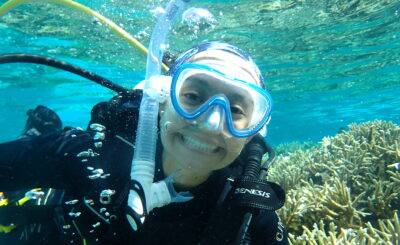
Madison Weise
Madison leverages environmental DNA to identify coral source and sink reefs in French Polynesia, helping guide coral reef management and conservation.
Cella Schnabel
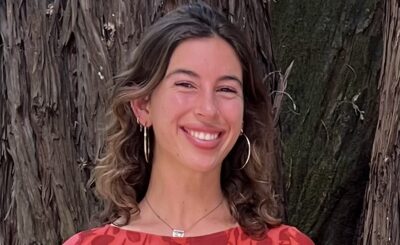
Cella Schnabel
Cella develops satellite-based tools to evaluate how community-led rangeland governance affects pasture health and climate resilience in northern Kenya.
Lily Heidger
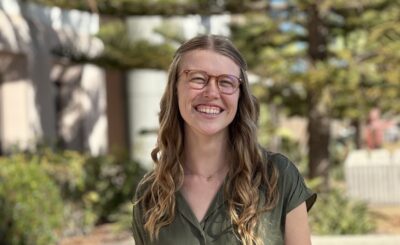
Lily Heidger
Lily analyzes how climate-driven hazards change transportation behavior to identify ways to make public transit more resilient and accessible.
Samantha Jerry
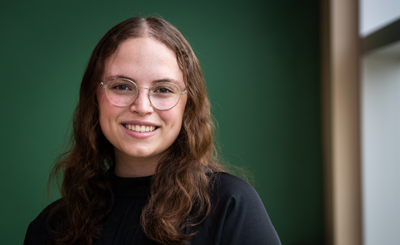
Samantha Jerry
Samantha investigates how mixotrophic plankton process carbon and nitrogen to enhance ocean biogeochemical models used for climate and ecosystem forecasting.
Haley Obenshain

Haley Obenshain
Haley applies tissue engineering and microfluidic technologies to develop new tools to accelerate coral growth and support reef restoration.
Wen-Tien Wang

Wen-Tien Wang
Wen-Tien develops a spatial model that integrates air pollution and health impacts to guide cleaner and more equitable decarbonization of the steel industry.
Alessandra Vidal Meza

Alessandra Vidal Meza
Alessandra uses animal-tracking data and causal inference methods to study how air pollution affects urban birds’ behavior and survival, informing targeted conservation strategies.
Lesley Figueroa

Lesley Figueroa
Lesley expands a cross-border photo-ID and citizen science program to track giant sea bass movement between California and Baja California to support international conservation efforts.
2025 Benioff Scholars
Madeleine Ward

Madeleine Ward
Madeleine studied how changes on coral reefs—especially the spread of macroalgae—affect herbivorous fish to inform fisheries management.
Kinsey Matthews

Kinsey Matthews
Kinsey leveraged joint dynamic species distribution models to reduce fisheries bycatch in the eastern tropical Pacific Ocean.
Natalie N. Dornan

Natalie N. Dornan
Natalie researched how nitrogen moves through the Channel Islands marine ecosystem and how those dynamics can support kelp forest restoration.
Lívia Machado Costa

Lívia Machado Costa
Lívia studied the economic and environmental factors shaping how small-scale cattle farmers engage with deforestation-free supply chains to identify ways to reduce deforestation.
James (Huck) Rees

James (Huck) Rees
James evaluated whether beaver-driven restoration can help solve environmental challenges in California, particularly in the Sierra Nevada.
Mukta Kelkar

Mukta Kelkar
Mukta worked on better understanding how marine protected area design features can make them more resilient to marine heatwaves.
Darwin Lara

Darwin Lara
Darwin investigated hidden neurotoxins produced by cyanobacteria to improve actionable monitoring in freshwater systems.
Olivia Ross

Olivia Ross
Olivia examined how forests recover following high severity fire and drought in the Sierra Nevada
Yutian Fang

Yutian Fang
Yutian used population dynamics modeling to estimate the status of U.S. marine mammal populations to fill critical data gaps and inform species management and conservation.
Have Questions?
Do you have any questions about the program or application? Send them our way!